EN

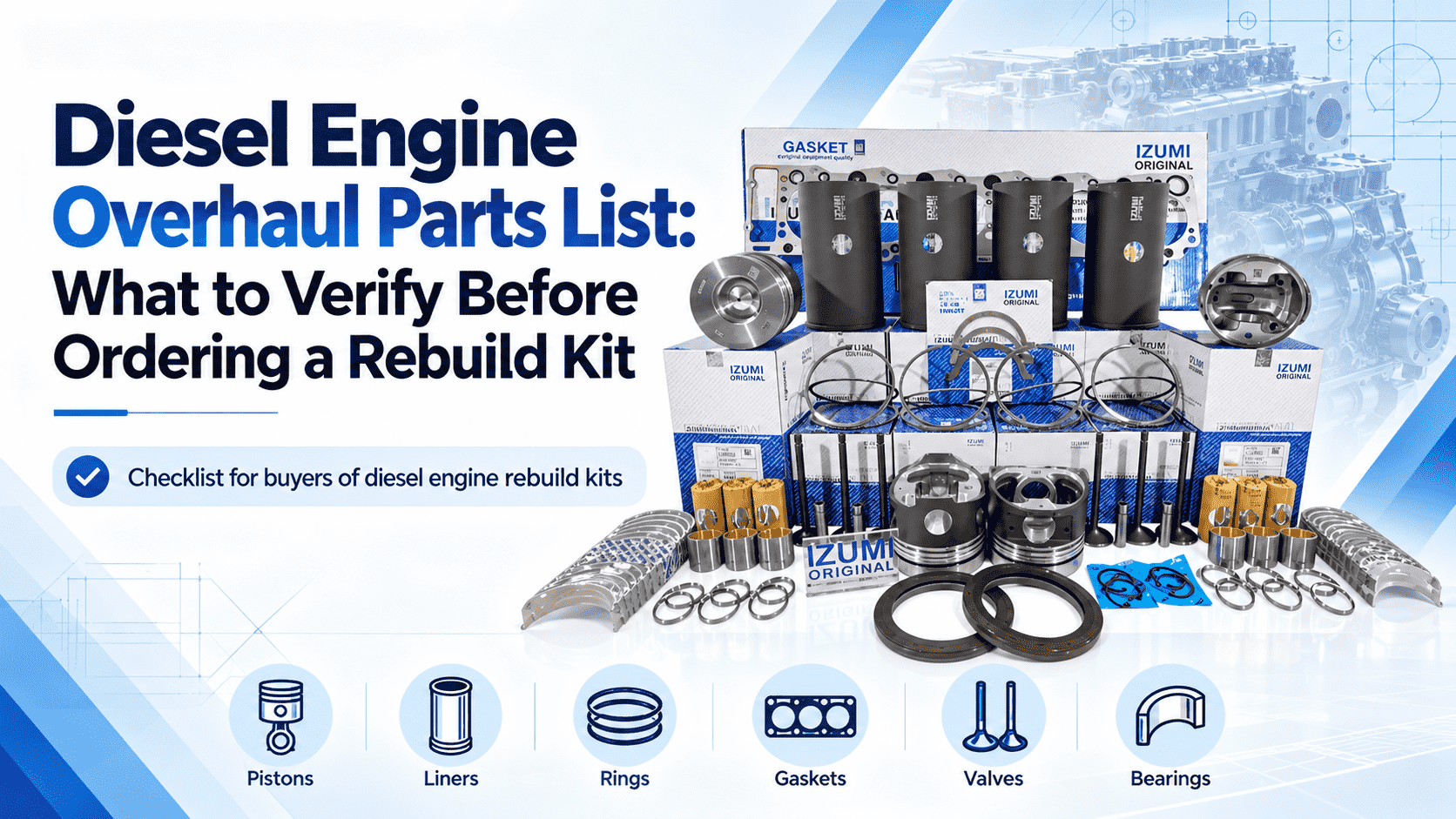
Diesel rebuild parts · purchase-scope verification guide
Diesel Engine Overhaul Parts List: What to Verify Before Ordering a Rebuild Kit
An engine overhaul parts list is not a universal shopping list. It is a repair-specific document built from the identified engine, its current parts catalog, inspection findings, and the exact contents offered by a supplier. Two packages described as a “full kit” can contain different components, quantities, or references. The safest order begins with a written scope, not a product photograph.
Why One Engine Overhaul Parts List Cannot Fit Every Rebuild
A diesel engine is repaired according to its identity and condition. The same family name may cover different builds, applications, production changes, or service histories. An installed engine may also differ from the machine’s original configuration. That is why a family label alone cannot prove that a piston, liner, bearing, gasket, valve, or pump is correct.
Commercial kit names add another layer of uncertainty. One seller may use “liner kit” for liners and sealing items; another may include pistons, pins, clips, and rings. “Full overhaul kit” may describe a broad package, yet still exclude parts that inspection shows are required. Conversely, buying the widest package before diagnosis can add components that do not match the build or are not needed.
The IZUMI ORIGINAL overhaul rebuild kit category is useful for discovering available product families. It should be treated as the start of an inquiry, not as a serial-specific bill of materials. A buyer must turn the repair plan into a controlled list with one row per component, part reference, quantity, evidence source, and approval status.
Official catalog systems reinforce this approach. Cummins QuickServe provides parts information tied to an Engine Serial Number, while Caterpillar’s parts resources explain that serial-number selection produces more precise fitment results than model-only searching. The practical lesson applies across brands: begin with the most specific current record available, then reconcile it with the physical engine and removed parts.
Identify the Exact Engine Before Listing Parts
Create an identification file before requesting prices. Photograph the complete machine plate and engine dataplate straight on, in focus, and with all edges visible. Transcribe the manufacturer, engine model, serial number, arrangement, CPL, specification, assembly, or build references exactly as shown. The relevant fields vary by manufacturer, so do not invent a missing value or copy one from a similar engine.
Record whether the engine is believed to be original to the machine and why. Service invoices, replacement-engine labels, and prior repair records may reveal a change. If the machine plate and installed engine point to different configurations, the installed engine identity and current service record need to be resolved before parts are selected.
Next, photograph removed components and labels before cleaning erases markings. Capture uncropped views plus close-ups of stamps, etched codes, casting marks, package labels, and visible construction features. Keep every part associated with its cylinder position or assembly location. A typed number in a message is weaker evidence than a legible photograph connected to an inspection record.
Finally, save the current catalog lookup: date, engine identifier used, illustration, item description, reference, quantity, and any supersession note. If a current number differs from the removed part, ask an authorized source or supplier to explain the relationship in writing. Similar appearance, a shared family name, or two numbers appearing in the same listing does not establish interchangeability.
A Practical Master Engine Overhaul Parts List
The table below is a planning framework, not a promise that every item belongs in every engine or kit. Use inspection and the current catalog to mark each group as required, reusable, separately sourced, or not applicable. Never copy dimensions, grades, clearances, torque values, or quantities from another model.
| Component group | Possible items to evaluate | Evidence needed before ordering |
|---|---|---|
| Cylinder group | Liners or sleeves, pistons, piston rings, pins, retaining clips, connecting-rod bushes, and specified seals | Catalog references, cylinder-by-cylinder inspection, old-part marks, and required quantities |
| Cranktrain | Main bearings, connecting-rod bearings, thrust components, bushes, and related fasteners when the manual requires replacement | Crankshaft and housing inspection, correct size or service condition from approved records, and catalog position |
| Sealing | Full gasket set, upper set, lower set, head gasket, oil seals, O-rings, and other application-specific seals | Set contents diagram, engine build, sealing-surface inspection, and written quantity |
| Valve train | Intake and exhaust valves, guides, seats, springs, stem seals, camshaft-related parts, and rocker components | Head inspection, catalog illustration, part markings, and machine-shop findings |
| Lubrication and cooling | Oil pump, water pump, thermostat, oil cooler-related seals, and passages or plugs specified for service | Failure diagnosis, pressure or condition testing under the correct manual, and exact assembly references |
| Fuel and air | Injectors, nozzles, fuel-pump items, turbocharger-related parts, filters, and intake or exhaust gaskets | System diagnosis, calibration or test results, build data, and current catalog applicability |
| Hardware and consumables | Specified one-time-use fasteners, plugs, clamps, sealants, filters, fluids, and cleaning materials | Current service procedure, local handling rules, and separately confirmed supply scope |
Use the broader engine parts directory to discover related component categories after the repair scope is known. Do not let a category page expand the order without inspection evidence. The parts list should explain why each line exists and who approved it.
From Inspection to an Orderable Rebuild Scope
1. Define the reason for teardown
Record symptoms, test results, operating history, contamination evidence, and the reason the engine was opened. A rebuild should address the verified condition, not merely replace the components most often photographed in a kit. Preserve samples and damaged parts when they may support a root-cause review.
2. Inspect before choosing the package
A qualified rebuilder should inspect the block, crankshaft, connecting rods, cylinder head, pistons, liners, valve train, lubrication system, cooling system, and other relevant assemblies using the service information for the identified engine. This article intentionally gives no universal measurement locations or acceptance limits. Those values must come from the correct manual and controlled shop procedure.
3. Convert findings into line items
For every required component, record the catalog description, current reference, quantity, position, inspection reason, and whether the item is expected inside a proposed kit. Separate “required for repair” from “included by seller.” This exposes gaps and prevents a broad kit name from hiding an omitted bearing, seal, gasket, or one-time-use item.
4. Compare the exact offered contents
The current 1KD/2KD overhaul kit page and 6BT/6BT5.9 overhaul kit page display multi-item kit descriptions. They are useful examples of why buyers should request a written, engine-specific contents list. A list shown for one product family must not be transferred to another engine or treated as proof of the shipped package.
5. Resolve every discrepancy before payment or installation
If the catalog, removed part, supplier quote, or photograph disagrees, stop the order. Ask for the source used to select the offered reference, clear label photos, and an explanation tied to the identified engine. Keep alternate and superseded numbers separate until their relationship is documented by current parts information or another authorized source.
Engine Rebuild Kit Quote Checklist
- Machine model and serial number are recorded from the complete plate.
- Engine model and serial number are recorded from the installed engine dataplate.
- Arrangement, CPL, specification, assembly, or build data are included when applicable.
- Current catalog evidence is saved for every requested component.
- Removed-part markings and packaging labels are photographed clearly.
- Inspection findings define which parts require replacement or further evaluation.
- The supplier lists every included item, reference, quantity, and packaging unit in writing.
- Items shown in photos but excluded from the quote are identified explicitly.
- Required items outside the proposed kit are listed as separate quote lines.
- No part-number equivalence, size, or application is accepted without a traceable basis.
- Price, stock, dispatch timing, certification, and warranty are confirmed only in the current quotation.
- The receiving plan requires inspection before cleaning, machining, modification, or assembly.
A useful comparison sheet has one row per component and one column per supplier. Compare exact references and quantities rather than kit totals alone. Also distinguish verified facts from open questions. A lower price is not comparable when the package omits required items or when compatibility remains unresolved.
Receiving Inspection Before the Workshop Uses the Parts
Quarantine the shipment until the receiving check is complete. Photograph the unopened package, shipping labels, internal labels, every component, and all visible markings. Count pieces and match them against the approved quote. Compare visible features with the removed parts and catalog illustrations, while recognizing that photographs cannot prove dimensions or material specifications.
If a label, reference, quantity, surface condition, or construction feature differs, stop. Keep the packaging and send side-by-side evidence to the supplier. Do not machine, clean aggressively, remove labels, or attempt installation while a mismatch is open. The workshop should complete any required measurements using calibrated tools and the correct engine service procedure.
Receiving approval does not replace installation control. Cleanliness, lubrication, measurement sequence, fastener policy, and assembly values must come from the current manual for the verified engine. Record who performed each check and retain the final parts list with the repair file.
Frequently Asked Questions
What parts are normally in a diesel engine overhaul kit?
There is no universal contents list. Packages may include some combination of cylinder, bearing, gasket, sealing, or valve-train items, but the exact contents must be stated by the seller and checked against the repair-specific list.
Is a full overhaul kit the same as an in-frame kit?
Do not assume so. These are commercial descriptions, and suppliers may use them differently. Ask for a line-by-line bill of materials and define the planned repair before comparing the names.
Can I order using only the engine model?
The model is a starting point, not complete evidence. Provide the engine serial number and any applicable arrangement, CPL, specification, assembly, or build data, then use the current catalog for that record.
Should I buy the kit before the machine shop inspects the engine?
Inspection should normally define the repair scope before the final order. Buying first can leave required items missing or supply parts that do not match the identified build or measured condition.
How should I handle an old part number that differs from the catalog?
Preserve the old marking and catalog result as separate evidence. Request a documented explanation of any supersession, substitution, or configuration difference. Do not infer equivalence from appearance or search results.
What information should I send to a supplier?
Send complete plate photos, machine and engine identifiers, applicable build data, current catalog records, removed-part markings, inspection findings, requested quantities, a written parts list, and clear photos. State the destination and ask for an itemized quotation.
Turn the Inspection Report into a Verifiable Order
Request a line-by-line kit check. Send the engine dataplate and serial number, applicable arrangement or build data, current catalog evidence, removed-part IDs, inspection report, required quantities, photographs, and destination through the IZUMI ORIGINAL contact page. Ask the quotation to identify every included component and the evidence used to match it.
Technical reference basis: Current IZUMI ORIGINAL category and product pages were reviewed on 6 October 2026. Official Cummins QuickServe and Caterpillar parts-support resources confirm the value of serial-specific parts lookup. No dimensions, torque values, serial-number breaks, universal kit contents, part-number equivalence, OEM identity, stock, price, certification, or warranty promise is asserted here.