EN
EN

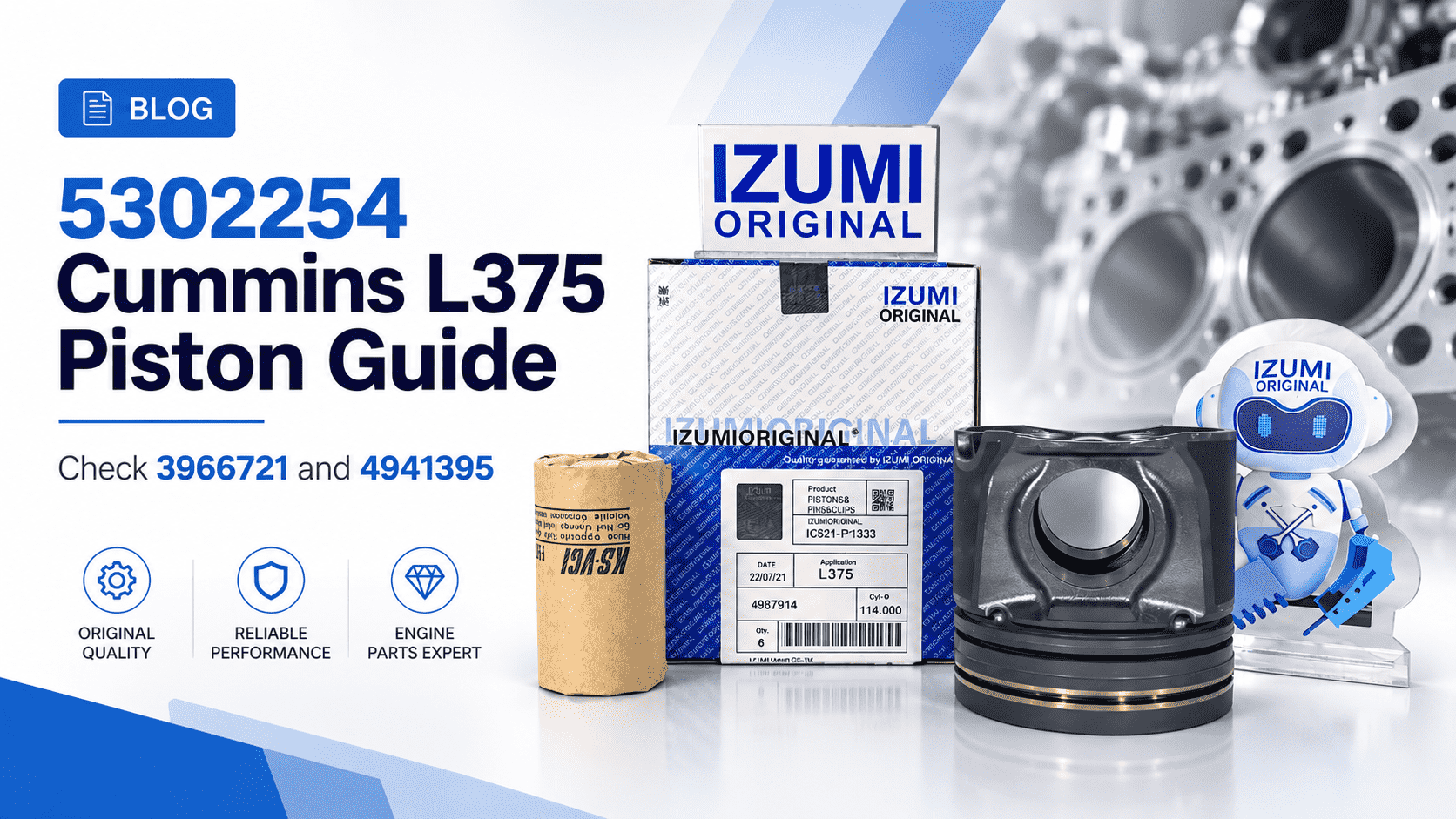
Cummins engine parts · piston purchase-verification guide
5302254 Cummins L375 Piston Guide: How to Check 3966721 and 4941395
A search for a Cummins L375 piston can place 5302254, 3966721, and 4941395 beside the same product family. That is useful for discovery, but it is not proof that the numbers are interchangeable, that they describe the same supplied assembly, or that any one of them fits every engine described as L375. A safe purchase begins with the exact engine record and the removed piston—not with a search-result title alone.
Why 5302254, 3966721, and 4941395 Need Separate Verification
The current IZUMI ORIGINAL L375 piston listing places several numeric references in one product title. The page identifies the item category as a piston, but a shared title does not explain whether the numbers reflect different configurations, service changes, assemblies, regional references, supersessions, or search terms. It also does not establish the contents of a piston kit.
Official Cummins resources follow the same engine-specific logic. QuickServe Online provides dataplate and parts-catalog information for an Engine Serial Number, while the Cummins parts catalog supports searches by serial number or part number and includes current part details and supersession information where available. The practical conclusion is simple: use the serial-specific record to decide what a number means for the engine in front of you.
The broader piston category can help a buyer understand the supplier’s product range. It cannot replace the engine-specific check. Similar photographs, a matching family name, or a number repeated by multiple websites does not prove fit, dimensions, material, compression design, pin arrangement, ring package, or kit completeness.
Build the Cummins L375 Engine Identity File First
Start with photographs of the complete engine dataplate. Take one straight-on image that shows every edge, then close-ups of each field. Transcribe the engine model, Engine Serial Number, CPL, advertised rating, and any other visible build or assembly identifiers exactly as printed. Do not fill a missing field from memory, from the machine model, or from a different engine of the same family.
Confirm that the installed engine is the engine being repaired. Equipment can receive replacement engines, long blocks, or major assemblies during its service life. Compare the machine record, prior invoices, overhaul tags, and engine plate. If the identifiers conflict, resolve the history before selecting parts. The installed engine and its current serial-specific catalog normally deserve more weight than an assumption based on the equipment model alone.
Save the catalog lookup as part of the job file. Record the date, identifier used, illustration or group, catalog description, part number, quantity, and any alternate or supersession note displayed by the current source. A screenshot without the Engine Serial Number context is incomplete evidence. If the supplier uses a different reference, ask for a written explanation that connects its offer to the same engine record.
Minimum identity package to send with an inquiry
- Complete engine dataplate photographs and a typed transcription.
- Engine Serial Number and CPL or other build information when shown.
- Machine model and serial number, clearly labeled as machine data rather than engine data.
- Current catalog screenshot or export showing the lookup context and date.
- Repair history that may indicate an engine or piston change.
- Required quantity, destination, and the workshop’s requested supply form.
Document the Removed Piston Before Cleaning or Disposal
The old piston is a second evidence source, not a substitute for the catalog. Photograph it before aggressive cleaning removes ink, labels, carbon patterns, or assembly clues. Capture the crown, skirt, pin-bore area, underside, ring-groove area, and every stamped, cast, etched, or printed marking. Include a job identifier in the frame and keep the piston tied to its cylinder position.
Ask the workshop to record condition as well as identity. Unusual crown damage, skirt scuffing, ring-land damage, pin-bore distress, foreign-object marks, overheating evidence, or uneven deposits may change the repair investigation. Replacing a piston without addressing the cause can repeat the failure. Diagnosis should therefore precede the final parts order.
Dimensions and acceptance criteria must come from the correct service information and a controlled workshop procedure. This guide intentionally provides no universal diameter, height, pin size, clearance, weight group, ring-groove value, or torque specification. The rebuilder should use calibrated tools, record the measurement locations, and compare the results only with the specification for the verified engine build.
| Evidence item | What to record | What it does not prove by itself |
|---|---|---|
| 5302254 | Where the reference appears, the associated catalog or listing context, and the exact engine record used | Interchangeability with 3966721, 4941395, or any other number |
| 3966721 | Old-part marking, catalog result, supplier quote line, and photographs | That every L375 build uses the same piston or kit |
| 4941395 | Current source, catalog position, description, quantity, and any documented change note | That a visually similar piston has the same dimensions or design |
| “L375 piston kit” | A line-by-line list of piston, pin, clips, rings, or other items actually offered | A standard kit definition or guaranteed contents |
| Product photograph | Visible features, labels, markings, packaging, and image date | Material, hidden geometry, measured conformity, stock, or the shipped configuration |
A Practical Cummins L375 Piston Part-Number Workflow
1. Separate observations from conclusions
Create a worksheet with one row for each reference. Under “observed,” note that a number appears on the old part, current catalog, product title, package label, or supplier quote. Under “verified,” record only relationships supported by the serial-specific catalog or another authorized, traceable source. Leave unresolved relationships open rather than converting them into assumptions.
2. Normalize the written references without changing them
Search systems may display a number with or without punctuation, but the purchase file should preserve the exact form from each source. Do not silently correct a digit or merge two similar numbers. A single transcription error can lead to a convincing but irrelevant result. Attach a photograph whenever the reference came from the physical part.
3. Match the catalog position and description
A valid number should be read in context: engine serial record, catalog group, illustration position, description, required quantity, and any notes. If a result belongs to a different assembly or engine configuration, it is not made applicable by sharing the word “piston.” Ask the supplier to quote against the same catalog evidence.
4. Define what the workshop is buying
“Piston,” “piston assembly,” and “piston kit” can describe different commercial scopes. The quote should state whether pins, retaining clips, piston rings, or any other components are included, excluded, or separately supplied. Do not infer contents from a photograph. The Cummins product collection is a useful route to related categories, but the final bill of materials must remain engine- and repair-specific.
5. Escalate every mismatch
If the catalog number, old-piston mark, offered reference, or visible design differs, pause the order. Ask for label photos, dimensional inspection data where appropriate, the source of the proposed cross-reference, and a written compatibility statement tied to the supplied Engine Serial Number. A mismatch is a question to resolve, not a reason to choose the number that appears most often online.
Supplier and Quote Verification Checklist
- The quote identifies the exact engine model and Engine Serial Number used for selection.
- CPL, build, or assembly information is included when it appears on the engine record.
- 5302254, 3966721, and 4941395 remain separate references unless a current source documents their relationship.
- The supplier states the offered part number exactly as it will appear on the label and invoice.
- The quote defines whether the offer is a bare piston, assembly, or kit.
- Every included component and quantity is listed in writing.
- Old-part markings and clear photographs have been reviewed.
- Any catalog-to-offer difference has a traceable written explanation.
- The workshop confirms required measurements using the correct service information.
- Packaging unit and total quantity match the engine and repair plan.
- Stock, price, dispatch date, certification, and warranty are confirmed only in the current quotation.
- The quote identifies what evidence is still missing or awaiting approval.
Inspect the Shipment Before Machining or Installation
Quarantine the shipment until the receiving check is complete. Photograph the outer package, shipping label, product label, individual components, and all visible markings. Match the invoice and labels to the approved quote. Count every item and confirm whether the promised supply form was delivered.
Compare the new and removed pistons side by side without assuming that visual similarity proves conformity. Record visible crown, bowl, gallery, skirt, pin-bore, ring-groove, and underside differences for review. A qualified workshop should perform the required dimensional and condition checks with calibrated tools and the correct serial-specific procedure.
If any number, label, quantity, surface, or visible feature differs, stop. Preserve packaging and send the evidence to the supplier. Do not clean aggressively, machine, modify, balance, or attempt installation while a discrepancy is open. Approval should be documented by the person responsible for the repair.
Frequently Asked Questions
Are 5302254, 3966721, and 4941395 interchangeable Cummins L375 piston numbers?
This article does not claim interchangeability. Their appearance in related search and product contexts is a reason to investigate. Confirm the correct reference and any documented relationship through the Engine Serial Number, current catalog, old-part evidence, and a written supplier response.
Can I order a Cummins L375 piston using only the engine model?
The model is not enough for a controlled purchase. Send the engine dataplate, Engine Serial Number, CPL or build data when present, current catalog result, old-piston markings, photographs, required quantity, and workshop findings.
Does “piston kit” always include rings and a pin?
No universal contents should be assumed. Ask the seller to list every component, part reference, and quantity. The written quote—not a generic photo or kit name—should define the supply scope.
What if the old piston number does not match the current catalog?
Preserve both records and stop the order until the difference is explained. It may reflect service history, a supersession, an alternate configuration, or a previous incorrect repair, but the cause must be documented rather than guessed.
Should the workshop measure the old and new pistons?
Yes, when the correct service procedure requires it. Use calibrated tools, controlled measurement locations, and specifications for the verified engine. Do not use universal values copied from an unrelated L-series application.
What should I send for a fast, useful supplier review?
Send complete plate photos, the Engine Serial Number, CPL or build data, current catalog evidence, all old-part markings, clear multi-angle piston photos, the inspection record, required quantity, supply scope, destination, and a list of unresolved questions.
Turn the Part Number into a Verifiable Purchase
Request an L375 piston check. Send the engine dataplate, Engine Serial Number, CPL or build information when available, current catalog record, old-piston markings, photographs, workshop inspection notes, required quantity, desired kit contents, and destination through the IZUMI ORIGINAL contact page. Ask the quotation to state the offered number and the evidence used to match it.
Technical reference basis: Current IZUMI ORIGINAL Blog, News, category, and L375 product pages were reviewed on 7 October 2026. Official Cummins QuickServe and parts-catalog resources support Engine Serial Number-specific lookup, dataplate review, part details, and supersession checks. No dimensions, torque values, serial-number range, part-number equivalence, universal kit contents, OEM identity, stock, price, certification, or warranty promise is asserted here.