EN
EN

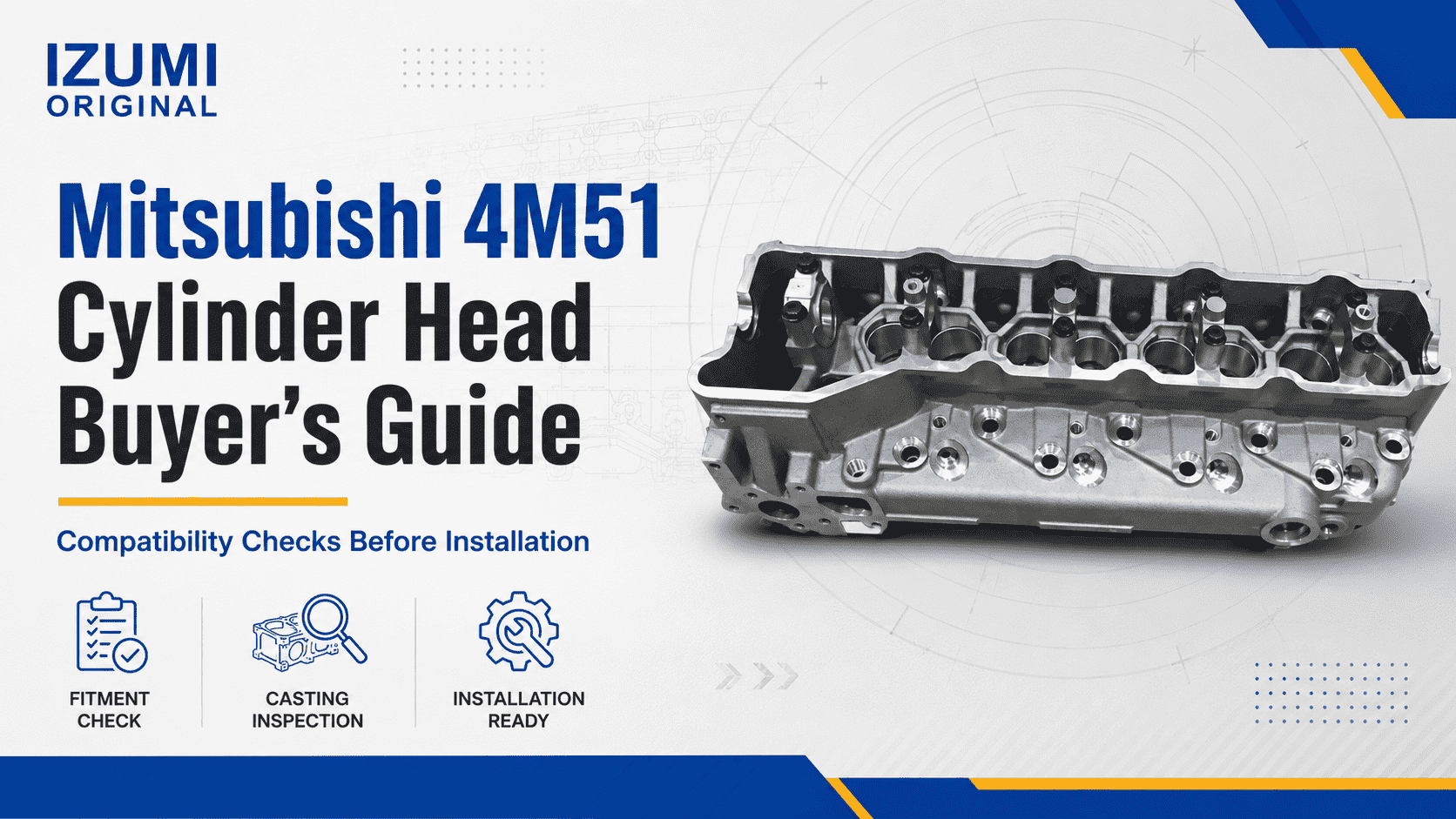
Mitsubishi engine parts · purchase verification guide
Mitsubishi 4M51 Cylinder Head Buyer’s Guide: Compatibility Checks Before Installation
Searching for a 4M51 cylinder head may lead to listings that place 4M40, 4M50, and 4M51 in the same title. That shared title is useful for discovery, but it is not proof that one casting or assembly fits every engine represented by those family labels. A safe purchase begins with the exact engine in the workshop, not with a photograph that looks similar.
Quick answer: before approving a Mitsubishi 4M51 cylinder head, document the complete engine identity, current catalog reference, removed-head markings, casting features, required assembly scope, and the workshop’s inspection findings. Ask the supplier to connect every quoted item to that evidence. If the engine serial data, catalog, old part, and offered head do not agree, stop and resolve the conflict before purchase or installation.
Table of Contents
Why “4M51 Cylinder Head” Is Not a Complete Specification
The live IZUMI ORIGINAL catalog contains an English 4M40, 4M50, and 4M51 cylinder head product page. It confirms that buyers can find a commercial listing under those model names. It does not establish that all three engines use an identical head, that every production revision is interchangeable, or that the pictured assembly matches the engine on your floor.
An engine-family search can hide model suffixes, production changes, equipment installation details, previous repairs, and the difference between a bare casting and an assembled head. Installed parts are evidence, but they are not automatically the original specification.
Identify the physical engine, record the workshop’s findings, and define the offered assembly. Browsing the Mitsubishi engine parts catalog can locate candidates, but a category match is not a fitment decision.
Build an Engine Identity File Before Requesting a Quote
Photograph the nameplate and record the complete data
Take a clear, uncropped photograph of the engine nameplate and transcribe every readable field. Record the exact model text and suffix, the complete engine serial number, and any specification, arrangement, or configuration reference that appears. Add the vehicle or equipment model, chassis or VIN, and equipment serial number as supporting data. Do not substitute the machine model for the engine identity.
Mitsubishi Fuso’s official owner information treats chassis and engine numbers as core vehicle reference data. That supports a simple purchasing rule: preserve those identifiers before disassembly and use the current service and parts information that applies to them. If the plate is missing or unreadable, do not guess from appearance. Ask a qualified parts specialist which additional physical identifiers and documents are needed.
Document the removed head as found
Photograph the old head from multiple angles before cleaning. Capture its markings, ports, mounting faces, openings, threaded features, sensor locations, and repair labels. Keep removed valvetrain components organized by position where practical.
A visible number may identify a casting, subcomponent, revision, or earlier replacement. Reconcile it with the current catalog. Document any disagreement before ordering.
Save the catalog evidence
Use a current parts catalog that covers the identified engine. Save the relevant page or screen showing the component description, reference, quantity, notes, and any applicable effectivity information. A search result, marketplace title, or handwritten cross-reference is not a substitute. When the catalog requires a serial break or another condition, have the supplier state which side of that condition applies and why.
Define What “Cylinder Head” Means in the Offer
“Bare head,” “complete head,” and “head assembly” are not universal bills of material. An offer may include selected valvetrain parts while excluding gaskets, fasteners, plugs, sensors, or manifolds. The photograph may not show the exact shipment.
Request itemized inclusions and exclusions. List the casting, valvetrain parts, seals, plugs, studs, fasteners, gasket, and other required components separately. The list makes the quote auditable; it does not imply that every item belongs in every order.
Separate fitment from availability, price, delivery, manufacturer identity, warranty, certification, and origin. Confirm these terms in the quotation; none proves compatibility. Use the engine parts directory for discovery, then return to the serial-specific catalog and inspection record.
Inspect the Engine and Old Head Before Ordering
A replacement head should not be used to bypass diagnosis. Ask why the old head is being removed and whether the initiating problem has been identified. Cooling-system faults, contamination, sealing problems, incorrect prior assembly, or damage elsewhere can affect the repair plan. Replacing one component without addressing the cause can expose the new part to the same failure mechanism.
Have a qualified workshop inspect the mating components
The workshop should inspect the old head, block deck, fastener holes, related sealing surfaces, valvetrain, lubrication passages, and cooling circuit as required by the correct service procedure. Any measurement, pressure check, crack test, surface decision, or reuse decision should be performed with suitable calibrated equipment and the approved procedure for the exact configuration and material.
This guide intentionally provides no flatness limit, height, pressure, torque, angle, sequence, or wear dimension. Those values can vary by procedure and configuration, and an uncontrolled number can cause an expensive error. Record the workshop result together with the manual edition or service-information source used.
Compare physical features without declaring equivalence
Ask the supplier for current photographs of the exact offered item and its label. Compare visible port layouts, openings, threaded locations, mounting faces, accessory interfaces, and casting identifiers with the old head and catalog illustrations. A visual match is a useful screen, but it does not prove material, machining, internal passages, dimensions, or catalog equivalence. Treat any difference as a question that requires documentation.
4M51 Cylinder Head Supplier Comparison Table
| Verification point | Evidence to send | Required supplier response | Reason to pause |
|---|---|---|---|
| Engine identity | Nameplate photo, exact model and suffix, full serial, machine or VIN context | Written statement of the identity used for lookup | Quote relies only on “4M51” or a vehicle description |
| Catalog reference | Current catalog page, notes, quantity, and applicable conditions | Offered reference mapped to that catalog evidence | Different number is proposed without documentary support |
| Old head | Overview images, markings, ports, openings, mounting faces, repair history | Current photos showing the same comparison points | Photos are generic, incomplete, or visibly different |
| Assembly scope | Line-by-line list of required head and valvetrain components | Explicit inclusions, exclusions, quantities, and condition | Supplier uses “complete” without an itemized list |
| Inspection basis | Workshop findings and applicable service-information reference | Confirmation that the offer matches the approved repair plan | Purchase is being made before diagnosis is complete |
| Commercial terms | Requested brand, documentation, delivery, warranty, and packing requirements | Current written terms tied to the exact offered item | Marketing text is treated as binding evidence |
Receiving and Pre-Installation Checklist
Preserve the approved quote, photographs, catalog pages, and workshop record. Compare delivered labels, markings, contents, and condition with them before assembly.
- Confirm that the delivered reference, suffixes, labels, and physical identifiers match the approved offer.
- Compare the delivered head with the old component and catalog illustrations at every documented interface.
- Have the qualified workshop inspect the replacement according to the applicable service procedure.
- Confirm the required gasket, fasteners, plugs, valvetrain parts, and related consumables separately.
- Use only the current torque sequence, values, angle procedure, and checks for the exact engine configuration.
- Resolve the original failure cause and complete the cooling, lubrication, and sealing checks required by the repair plan.
- Stop if labels, markings, features, quantities, documentation, or inspection results differ from the approval record.
Do not alter or install a disputed part to see whether it works. Preserve the evidence and resolve the discrepancy before assembly.
Common 4M51 Cylinder Head Buying Mistakes
Assuming a combined title proves interchangeability
A title containing 4M40, 4M50, and 4M51 may group a seller’s product area. It is not a technical interchange statement. Require a current catalog basis for the exact engine and offered reference.
Approving from one old casting mark
The mark is important evidence, but its meaning must be established. Compare the complete old part, engine identity, catalog, and repair history. Do not convert a partial or unclear mark into a claim of part-number equality.
Leaving “complete” undefined
Buyers often discover missing valvetrain or sealing items only after delivery. Make the supplier list every included component and quantity. Confirm separately what the workshop plans to reuse.
Skipping root-cause and block inspection
A new head cannot correct every cause of overheating, leakage, contamination, or sealing loss. Complete the diagnosis and mating-component checks before the order is finalized.
Copying workshop figures from an uncontrolled source
Generic web figures may belong to another engine, revision, material, or procedure. Obtain the current service information for the exact configuration. Mitsubishi Fuso provides official pathways for service information; use the documentation appropriate to the vehicle and market, or consult a qualified service provider.
Frequently Asked Questions
Is a 4M51T cylinder head automatically the same as a 4M51 head?
Do not assume so from the related names. Compare the full model and suffix, serial or configuration data, current catalog references, old-head markings, and all relevant interfaces. Require the supplier to document the offered fitment basis.
Can I order the head using only the vehicle model?
The vehicle or equipment model is useful supporting context, but it should not replace the engine nameplate, serial data, VIN or chassis information, catalog lookup, and removed-part evidence. Send all available identifiers.
Should I buy a bare head or an assembled cylinder head?
That depends on the verified repair plan, the condition of reusable components, workshop capability, and the exact contents of the offer. Ask the workshop to define the required scope, then compare itemized quotes rather than package labels.
Does a matching photograph prove compatibility?
No. Photographs help reveal obvious differences and preserve markings, but they cannot prove internal passages, material, machining, dimensions, or catalog equivalence. Use them together with controlled documents and inspection.
Where should installation specifications come from?
Use current service information for the exact engine identity and procedure. Have a qualified workshop confirm the applicable manual and record its inspection and assembly results. This guide does not provide universal specifications.
What should I send with a 4M51 cylinder head inquiry?
Send the engine nameplate, full serial and configuration data, vehicle or equipment identifiers, current catalog page, old-head markings and photos, workshop findings, required assembly contents, quantity, and written commercial requirements. Ask for current photos and a line-by-line verification response.
Prepare a Traceable Cylinder Head Inquiry
Collect the engine identity, catalog evidence, old-head photographs, inspection record, and itemized scope before asking for a quote. Then contact IZUMI ORIGINAL and request a written response that maps the offered head and every included component to your documents.
For related purchasing controls, read the Mitsubishi 4M40 rebuild kit checklist. The same evidence-first principle applies: family names and photos help discovery, while the engine plate, current catalog, old-part markings, and qualified inspection control approval.
Verification Note
This guide uses the live IZUMI ORIGINAL product and category pages to confirm that the referenced commercial pages exist. It also consulted official Mitsubishi Fuso service-information and owner-reference resources for the principle of using controlled service information and recorded engine identification. It does not claim dimensions, torque values, serial-number ranges, applications, part-number equivalence, OEM identity, stock, price, certification, delivery, or warranty. Buyers must verify the exact engine nameplate, serial and configuration data, current parts catalog, old-part markings, photographs, and workshop inspection before ordering or installation.
Table of Contents
- Table of Contents
- Why “4M51 Cylinder Head” Is Not a Complete Specification
- Build an Engine Identity File Before Requesting a Quote
- Define What “Cylinder Head” Means in the Offer
- Inspect the Engine and Old Head Before Ordering
- 4M51 Cylinder Head Supplier Comparison Table
- Receiving and Pre-Installation Checklist
- Common 4M51 Cylinder Head Buying Mistakes
-
Frequently Asked Questions
- Is a 4M51T cylinder head automatically the same as a 4M51 head?
- Can I order the head using only the vehicle model?
- Should I buy a bare head or an assembled cylinder head?
- Does a matching photograph prove compatibility?
- Where should installation specifications come from?
- What should I send with a 4M51 cylinder head inquiry?
- Prepare a Traceable Cylinder Head Inquiry
- Verification Note