EN
EN

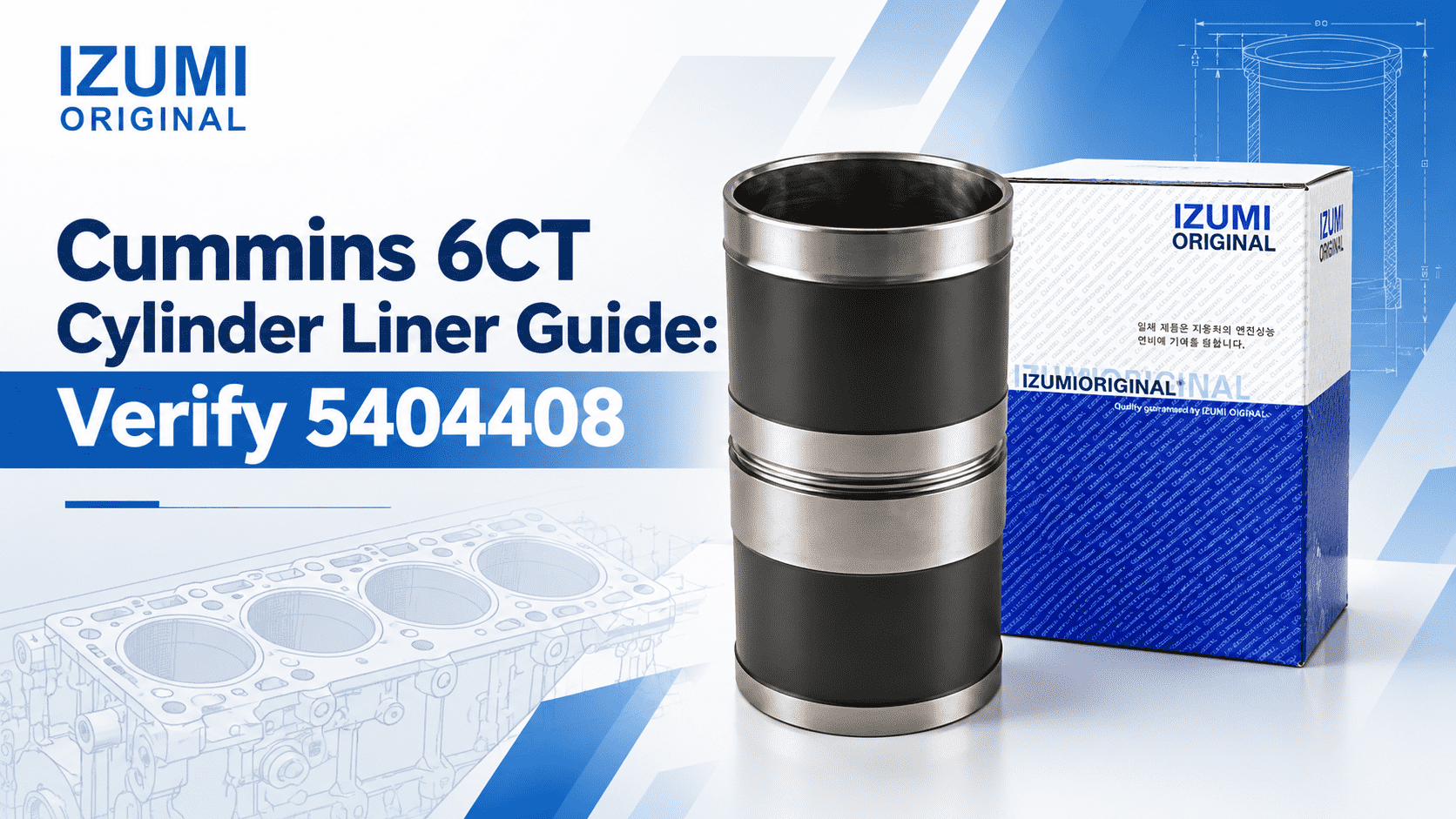
Cummins engine parts · cylinder-liner purchase verification
Cummins 6CT Cylinder Liner Guide: How to Verify 5404408 Before Ordering
A search for a 5404408 cylinder liner may lead to a product title that also lists 3948095, 3800328, 3944344, 3907792 and 3919937 for a Cummins 6CT. That is a useful discovery lead, but it does not prove that every number is interchangeable or suitable for every engine called 6CT. A defensible order connects the proposed liner to the engine serial number, current parts information, the removed liner, measured block condition and a written supplier confirmation.
Contents
Why 5404408 Is a Starting Reference, Not a Complete Specification
The live IZUMI ORIGINAL page for a Cummins 6CT cylinder-liner listing containing 5404408 places 3948095, 3800328, 5404408, 3944344, 3907792 and 3919937 in the same title. This helps a buyer find a relevant product family. The page, however, does not establish that those references are equal, that one supersedes another, or that they share the same dimensions and application limits.
The title also does not provide a serial-number range, CPL or build mapping, controlled drawing, finished dimensions, machining allowance, liner type, installation procedure, protrusion target or torque values. Without those items, the page cannot be used as a stand-alone purchase specification. Treat every displayed number as a reference to verify separately in current, controlled information.
Ask the supplier to state the exact number that will appear on the quotation, invoice, package and permanent part marking. If a different number is proposed, request the current catalog or manufacturer documentation that explains the relationship. Similar appearance, a shared page title or a supplier database cross-reference is not enough evidence by itself.
Step 1: Identify the Exact Engine Before Discussing the Liner
Begin with the engine physically in the machine. Photograph the full dataplate and its location, then transcribe the engine model, engine serial number and all available build information exactly. Record the equipment model and equipment serial number separately. If the engine was replaced, rebuilt or transferred, the machine record may no longer identify the installed engine correctly.
Cummins QuickServe Online explains that parts content and service documents can be accessed by engine serial number or engine family, including the parts catalog and dataplate information for a specific engine. That is the appropriate verification principle: “6CT” describes a family, while the serial-specific record identifies the build that must be checked.
Send a complete identification packet
- Clear engine and equipment dataplate photographs, plus typed transcriptions.
- Engine serial number and CPL, build or configuration data when available.
- A dated screenshot or export from the current serial-specific parts catalog.
- Any record of an engine replacement, block change, machining or previous overhaul.
- The equipment application as context, not as a substitute for engine identification.
The Cummins engine-parts collection and cylinder-liner category can help locate product families. Category placement is useful for navigation, but it does not confirm serial-specific fitment.
Step 2: Preserve Evidence From the Removed Liner
Do not discard, mix or aggressively clean the old liners before they are documented. Number each cylinder position, photograph the liner as removed and keep its identifying marks associated with that position. Capture the top flange, outer surface, lower area, sealing regions, bore surface and any stamped, etched or printed marks. Photograph a scale beside the part for visual context, but do not use a photograph as a dimensional acceptance record.
Transcribe every readable mark exactly, including spaces, hyphens, logos and suffixes. A partial mark should be reported as partial rather than reconstructed from memory. Note whether all removed liners carry the same identification. Mixed markings may reflect an earlier repair, and that history must be reconciled before a complete set is approved.
Record observable condition without converting it into a premature root-cause claim: corrosion, cavitation-like erosion, polishing, scoring, heat discoloration, cracking, deposits, sealing-area damage or unusual wear. These observations guide inspection, but they do not prove the replacement part number. The workshop should retain representative parts until catalog selection, dimensional review and supplier confirmation agree.
Do not confuse three separate decisions
Catalog identification, block-condition assessment and machining strategy are connected but different. The catalog can identify a service part for the original build. The removed liner shows what was installed. Measurements show the present repair condition. A safe order reconciles all three instead of allowing any one source to overrule the others without explanation.
Step 3: Inspect the Block and Define the Repair Scope
A qualified workshop should inspect the block, liner counterbores or seating areas, parent bores, deck, sealing surfaces and cooling passages using calibrated tools and current service information for the confirmed engine. The measurement sheet should identify the instrument, unit, measuring location, result, technician and service-document source. This guide deliberately supplies no dimensions or limits because those values must match the exact serial-specific build and repair condition.
Ask the workshop to explain whether the block condition is acceptable for the intended service part and whether machining, repair or additional components are required. Terms such as “standard,” “finished,” “semi-finished” or “repair size” are incomplete unless the supplier defines the term, the measured feature it refers to and the controlled document supporting the choice.
Also define what is included in the order. A bare liner is not the same commercial scope as a cylinder kit, liner set or overhaul kit. Request a line-by-line list of liners, seals, rings, pistons, pins, clips, gaskets and any other components offered. Do not infer quantity or kit content from a photograph or the word “set.”
The repair plan should address the reason for disassembly and the condition of related systems. A correctly identified liner will not correct unresolved overheating, contamination, coolant problems, lubrication issues, block damage or incorrect installation. Diagnosis and parts selection should support each other while remaining separately documented.
5404408 Cylinder Liner Purchase Checklist
- The engine and equipment dataplate photos are clear and fully transcribed.
- The engine serial number and CPL, build or configuration data are included when available.
- A current serial-specific parts record identifies the required liner reference and quantity.
- 5404408, 3948095, 3800328, 3944344, 3907792 and 3919937 are treated only as references to verify.
- No pair of numbers is accepted as equivalent or superseding without current documentary support.
- Each removed liner is mapped to its cylinder position and photographed before disposal.
- All readable markings and significant physical features are recorded accurately.
- The block, seating areas, bores, deck and cooling passages have been inspected.
- The measurement sheet names tools, units, locations, results and the service source.
- The supplier defines liner type and any size or finish terminology in writing.
- The quotation itemizes every component, exclusion and total required quantity.
- Installation will follow current serial-specific service procedures and limits.
How to Compare Two Cylinder-Liner Quotations
| Quotation field | What a useful answer should show | Risk if missing |
|---|---|---|
| Identification basis | ESN, CPL/build data and dated serial-specific catalog result checked | A family-name match may hide a build difference |
| Exact reference | Number on quote, invoice, package and permanent part marking | The delivered reference may differ from the approved item |
| Number relationship | Traceable support for any alternate or supersession claim | Same-page numbers may be mistaken for proven equivalents |
| Liner definition | Written liner type, finish or size status tied to catalog and measurements | An undefined label can cause a machining or fit error |
| Scope and quantity | Every liner, seal, kit component, inclusion and exclusion itemized | “Set” may describe different contents |
| Evidence trail | Photos, old marks and inspection sheet attached to the quotation | Approval may be separated from the engine evidence |
Compare price only after both suppliers describe the same verified scope. Keep the identification packet, catalog result, removed-part images, measurement sheet, supplier response and approved quotation together. That record gives receiving staff and the workshop a clear basis for stopping if the shipment differs from what was approved.
Receiving and Pre-Installation Controls
Quarantine the shipment until the package labels, permanent markings, invoice, quantity and approved quotation agree. Photograph the unopened package and each component. Check for damage, corrosion, contamination, mixed markings, missing components or evidence of repacking. Retain labels and protective packaging until the workshop has completed its acceptance checks.
Compare observable features with the approved evidence, while recognizing that appearance alone cannot confirm dimensions, material or fitment. The workshop should repeat required measurements and use current service information for preparation, cleanliness, sealing components, lubricant or assembly requirements, liner installation, protrusion checks and fastener torque values. Those values should come from controlled documentation for the confirmed engine, not from a generic web article.
Stop before machining, modification or installation if a reference, mark, feature, quantity or written definition differs. A variation may have a legitimate catalog explanation, but the supplier should document it against the same engine serial number and measured repair condition. Once a part is altered or installed, evidence can be lost and a return or failure investigation becomes harder.
Frequently Asked Questions
Are 5404408 and 3948095 interchangeable?
Do not assume so. They appear together in a live product title, but that does not prove equivalence, supersession, dimensions or serial-specific fitment. Check both references in current parts information for the identified engine and request written support for any relationship.
Can I order by “Cummins 6CT cylinder liner” alone?
No reliable order should rely on the family name alone. Provide the ESN, CPL or build data when available, current catalog result, removed-liner markings, photographs, workshop measurements, repair scope and quantity.
Is the number on the old liner enough?
It is valuable evidence of what was installed, but an earlier repair may have used another reference or repair strategy. Reconcile the marking with current catalog information and the measured block condition.
What should the supplier confirm in writing?
Request the exact supplied number, catalog basis, liner definition, package and part markings, contents, exclusions, quantity and evidence for any alternate or supersession claim.
Why are measurements needed when the ESN is known?
The ESN establishes the catalog basis, while measurements establish the engine’s present condition. Wear, corrosion, previous machining or component changes can affect the repair decision. Both evidence streams are necessary.
Does the product page prove that all six listed numbers fit my engine?
No. Their shared appearance is a search lead only. Each reference needs the same serial-specific catalog, physical and dimensional verification before it can be accepted for purchase.
Send a Verification-Ready 5404408 Inquiry
Prepare one file containing the dataplate, ESN and build data, current catalog result, old-liner markings, photographs, measurement sheet, repair scope and quantity. Then contact IZUMI ORIGINAL and request written confirmation for the proposed 5404408 cylinder liner before ordering.