EN
EN

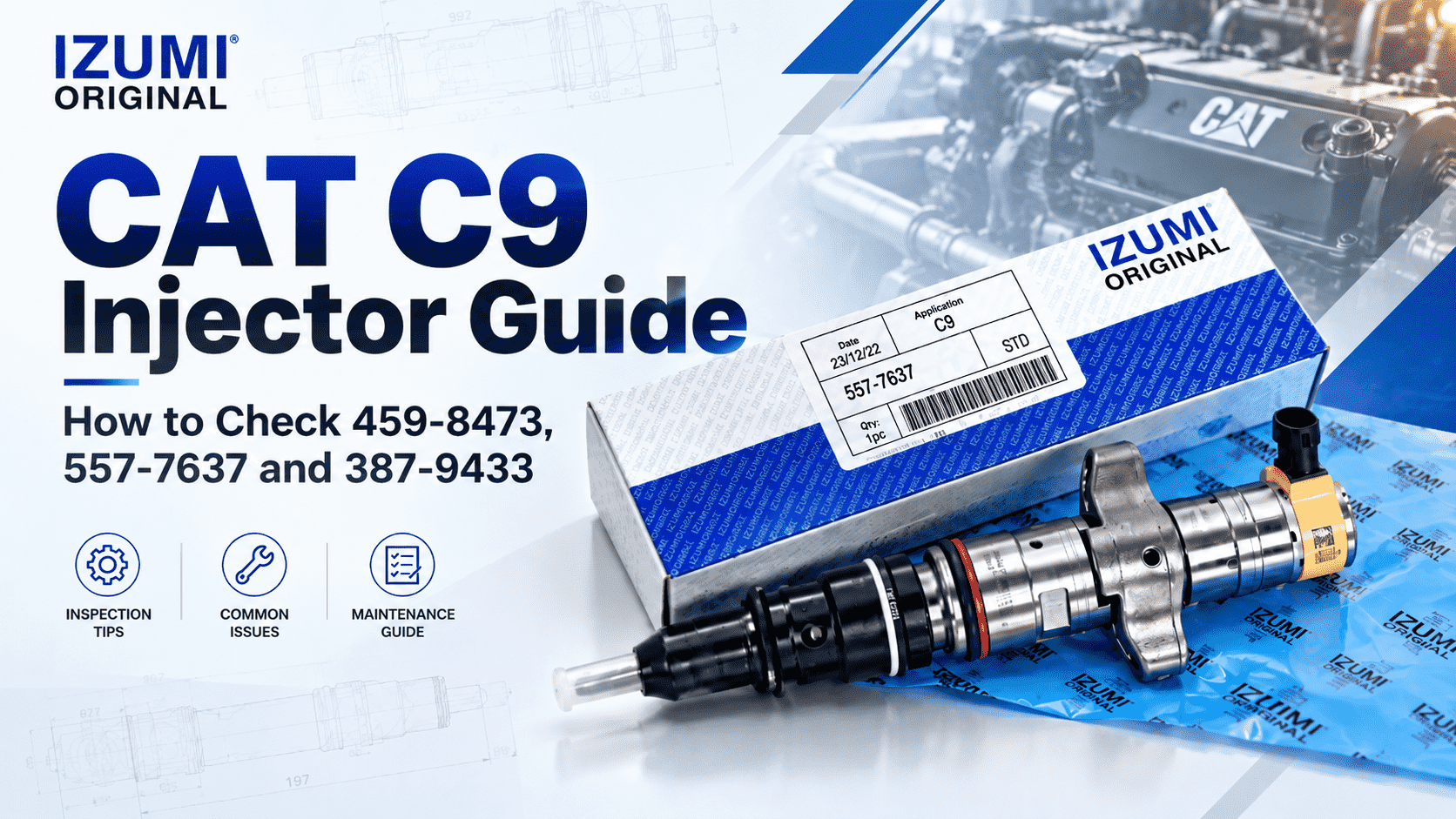
Caterpillar engine parts · injector purchase-verification guide
CAT C9 Injector Guide: How to Check 459-8473, 557-7637 and 387-9433
A search for a CAT C9 injector can place 459-8473, 557-7637, and 387-9433 on the same product page. That helps discovery, but it does not prove that the references are interchangeable, supersessions, or correct for every C9. A controlled purchase starts with exact machine and engine identity, current catalog evidence, the removed injector, and a traceable written offer.
Why 459-8473, 557-7637, and 387-9433 Need Separate Verification
The current IZUMI ORIGINAL CAT C9 injector product page identifies the item as an injector and places all three references in its title. That is verified page content. The page title alone does not establish whether those references describe alternatives, updates, market-specific listings, or different configurations. It also does not define a serial-number range, calibration requirement, or complete equipment application list.
The engine family name is only the beginning. Machines in the same family may differ by build, arrangement, emissions configuration, control strategy, or service history. An engine may have been replaced or rebuilt, and a prior repair may have introduced a part that does not match the original build record. Use evidence from the exact machine and engine being repaired.
The broader Caterpillar parts collection and engine-parts directory help buyers navigate related products. They are not substitutes for a serial-specific catalog lookup. Caterpillar's own Parts Store help explains that a model search can narrow results, while searching with an equipment serial number gives a more precise fitment check. That principle matters when an injector listing contains several numbers.
Build the Machine and Engine Identification File First
Photograph the complete machine identification plate and engine identification plate before parts are removed. Take straight-on images, close-ups of every readable field, and wider photographs that show where each plate or stamping is located. Transcribe the machine model, PIN or serial number, engine serial number, arrangement or configuration information, and any visible build data exactly. Do not fill missing characters from memory or from another machine.
Keep machine identity and engine identity in separate fields. Record whether the engine is believed to be original, replaced, remanufactured, or previously rebuilt, but label undocumented history as unknown rather than fact. If the machine record, engine plate, electronic report, and old-part evidence disagree, resolve that conflict before a purchase is approved.
Use the verified identifiers in the current catalog or service-information system. Save the lookup date, catalog source, selected asset, illustration or group, item description, number, quantity, and every note shown. A screenshot containing only a part number is weak evidence because it does not connect the result to the engine. Preserve enough context for a second person to reproduce the lookup.
Minimum evidence to send with an inquiry
- Machine model and PIN or serial-number photographs with a typed transcription.
- Engine data plate or stamping, including serial and arrangement/configuration fields when present.
- Current catalog evidence showing the selected asset, group, item, quantity, notes, and lookup date.
- Every old-injector marking, label, connector view, and prior package or invoice reference.
- Workshop diagnosis notes, electronic reports if applicable, required quantity, and destination.
- The requested supply condition and any core-return requirement.
Separate Injector Diagnosis from the Purchase Decision
Hard starting, smoke, misfire, uneven running, power loss, a fault code, or fuel dilution may justify diagnosis, but no single symptom identifies an injector part number or proves that the injector is the root cause. The qualified workshop should follow the correct diagnostic procedure for the verified machine and engine. Fuel supply, filtration, contamination, wiring, connectors, control signals, compression, related components, and previous repair work may require investigation.
Caterpillar guidance emphasizes contamination control because small amounts of dirt or water can damage injectors, pumps, and rails. Record fuel condition, filter findings, samples, and any contamination event before disturbed evidence is cleaned or discarded. Keep measured results separate from conclusions. If an injector is removed, protect openings and label every component so parts from different cylinders or jobs cannot be mixed.
Do not copy test limits, electrical values, torque specifications, or installation steps from a generic page. Obtain them from the correct service information for the verified arrangement. The responsible technician should approve the repair and parts list before purchasing.
A Practical CAT C9 Injector Part-Number Workflow
1. Record each reference exactly
Create separate rows for 459-8473, 557-7637, and 387-9433, plus unhyphenated forms such as 4598473 only when they appear in a source. For each row, record whether the number came from the old part, package, invoice, catalog, product page, or supplier quotation. Search engines may ignore punctuation, but a buyer must not assume that punctuation is the only difference between two catalog references.
2. Match the number to a catalog position
Read the result in context: selected asset, engine arrangement, illustration, item position, description, quantity, and notes. Confirm that the catalog describes the complete injector or the exact service item being quoted rather than a nozzle, seal, connector, hold-down, line, or related component. If a replacement or supersession relationship is displayed, preserve the full note and lookup context.
3. Compare the removed injector without treating appearance as proof
Photograph all stamped, etched, printed, and label information before cleaning. Capture the connector, electrical keying, inlet and return features, body and tip, mounting details, and cylinder position. Do not infer flow, calibration, internal construction, or compatibility from outward similarity. If a code or identifier may require programming or calibration, ask the workshop and supplier to state the applicable procedure for the verified engine; do not guess.
4. Define the commercial supply scope
Require the quotation to state whether the offer is new, remanufactured, rebuilt, tested used, or another precisely defined condition. Ask for the offered number as it will appear on the label and invoice, all included seals and hardware, unit quantity, packaging unit, and any core-return or programming condition. Product photographs may be illustrative and must not control the supply scope.
5. Resolve every mismatch before payment
If the old marking, serial-specific catalog result, supplier number, label photograph, connector, or quotation differs, stop the order. Ask for traceable catalog evidence and a written explanation tied to the identifiers you submitted. Do not choose the number that appears most often online, and do not treat co-listing on a sales page as proof of equivalence.
| Evidence | What to capture | What it does not prove alone |
|---|---|---|
| 459-8473 | Exact source, selected asset, catalog context, date, and offered label | Universal C9 fit or equivalence to another listed number |
| 557-7637 | Illustration, item description, quantity, notes, and supplier offer line | A replacement relationship not documented by a current source |
| 387-9433 | Old-part evidence, catalog result, quote context, and any stated conditions | Matching calibration, connector, or internal configuration |
| Removed injector | All markings, cylinder position, connector, inlet/return, body, tip, and job identity | That a previous repair installed the correct injector |
| Product image | Visible label, features, packaging, image date, and quotation reference | Hidden configuration, test status, stock, or supplied contents |
| Written quotation | Condition, number, quantity, inclusions, selection evidence, and open conditions | Installation approval before receiving inspection |
Supplier and Quote Verification Checklist
- The quote identifies the machine and engine records used for selection.
- The offered injector number is written exactly as it will appear on the label and invoice.
- 459-8473, 557-7637, and 387-9433 remain separate unless current evidence documents their relationship.
- The catalog source, lookup date, selected asset, group, item, quantity, and notes are recorded.
- Old-injector markings, connector views, labels, and multi-angle photographs have been reviewed.
- The quote clearly states condition: new, remanufactured, rebuilt, tested used, or another defined option.
- Included seals, hardware, accessories, packaging unit, and total quantity are listed line by line.
- Any core return, coding, programming, calibration, or installation condition is stated without assumption.
- Every mismatch between catalog, old part, and offered item has a traceable written explanation.
- The workshop confirms the required service steps using application-specific information.
- Stock, price, dispatch date, certification, warranty, and return terms are confirmed only in the current quotation.
- Missing evidence and unresolved approval conditions are visible before payment.
Receiving and Pre-Installation Control
Quarantine the shipment until receiving inspection is complete. Photograph the outer package, shipping label, product label, seals, protective caps, and each injector from all sides. Match the invoice and labels to the approved quotation. Count the items and included components before packaging is discarded or any core is returned.
Compare the received and removed injectors side by side, using appearance only as a screening step. Record differences in markings, connector, inlet and return features, mounting details, seals, and hardware. Escalate every unexplained difference. Do not install, modify, or surrender the old unit while approval is pending.
The workshop must control cleanliness and follow the correct service procedure. It should determine the applicable preparation, seal replacement, fastener values, coding or calibration steps, fuel-system priming, leak checks, post-installation tests, and documentation. This guide deliberately supplies no universal torque, pressure, electrical, calibration, or trim-code instruction.
Frequently Asked Questions
Are 459-8473, 557-7637, and 387-9433 interchangeable CAT C9 injector numbers?
This guide does not claim interchangeability. The numbers appear together on the current product page, but the buyer must confirm their relationship with serial-specific catalog evidence, the removed injector, and a written supplier response.
Can I order a C9 injector using only the engine family name?
No controlled purchase should rely on the family name alone. Submit the machine PIN or serial, engine serial and arrangement/configuration data when present, current catalog result, old-part markings, photographs, diagnosis findings, quantity, and destination.
Does a fault code prove that an injector must be replaced?
No. A code is diagnostic evidence, not a complete purchase specification. A qualified workshop should follow the correct troubleshooting procedure and consider the fuel, electrical, control, mechanical, and contamination context before approving replacement.
Should the supplier confirm calibration or programming requirements?
Yes. Ask the supplier and workshop to state any applicable condition for the verified engine and offered injector. Do not copy a code or procedure from another engine, and do not assume that every listed reference uses the same process.
What if the received injector looks different?
Stop and document every difference. Preserve the packaging, compare the catalog and quotation, and request written clarification. A visual difference does not automatically prove the part is wrong, but it must not be ignored without traceable approval.
What should I send to request a useful quotation?
Send complete machine and engine identification, current catalog evidence, old-injector markings and photographs, diagnosis notes, condition and supply preference, quantity, destination, and a request for the offered number and selection evidence in writing.
Turn the Search Reference into a Verifiable Purchase
Request a CAT C9 injector check. Send the machine PIN or serial, engine serial and arrangement/configuration data when available, current catalog result, old-injector markings, label and connector photos, diagnosis notes, required quantity, preferred supply condition, and destination through the IZUMI ORIGINAL contact page. Ask the quotation to state the offered number and the evidence used to match it.
Technical reference basis: Current IZUMI ORIGINAL Blog, News, relevant product and category pages, and Caterpillar guidance were reviewed on 9 October 2026. Co-listing is not proof of equivalence. No dimensions, service values, calibration code, serial range, application, OEM identity, stock, price, certification, shipping promise, or warranty is asserted.