EN
EN

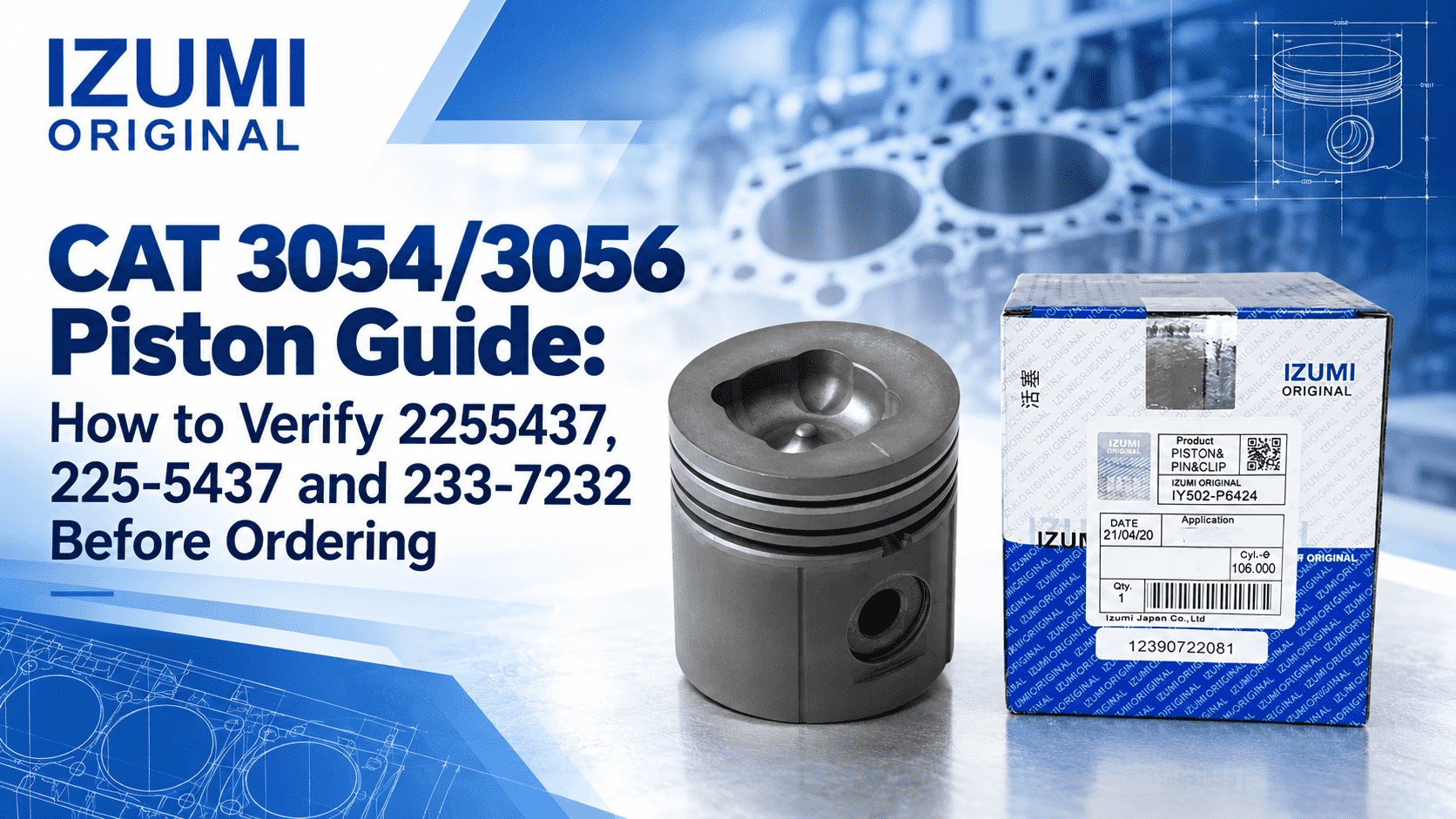
Caterpillar engine parts · piston purchase verification
CAT 3054/3056 Piston Guide: How to Verify 2255437, 225-5437 and 233-7232 Before Ordering
A search for a 2255437 piston may also surface 225-5437 and 233-7232 on the same supplier page. That shared listing helps a buyer find a starting point, but it does not prove that the numbers are interchangeable or that one piston fits every engine described as 3054 or 3056. A reliable order connects the proposed piston to the exact engine record, current parts information, the removed component, measured rebuild condition, and a written supplier response.
Contents
Why 2255437, 225-5437 and 233-7232 Are Search Clues, Not a Fitment Decision
The live IZUMI ORIGINAL page for a piston listed with 2255437, 225-5437 and 233-7232 places all three references in one title and associates the listing with 3054/3056 and Caterpillar. The two forms 2255437 and 225-5437 contain the same digits, so searching both is practical. The presence of 233-7232 on the same page is also useful for discovery. However, a supplier title is not a current serial-specific parts record and does not establish equivalence among the references.
The page does not publish a serial-number range, engine arrangement mapping, dimensional drawing, piston bowl profile, pin specification, compression height, repair-size status, material, coating, weight group, installation clearance, or current supersession path. Without those details, a photograph and a familiar number cannot define a safe purchase. The page should start an inquiry, not end the verification process.
Ask the supplier to state which exact number will appear on the quotation, invoice, package, and part marking. If the supplier calls one number an alternate or replacement for another, request the current catalog or manufacturer documentation supporting that relationship for the identified engine. Keep punctuation variants separate from true supersessions: removing a hyphen may only change formatting, while a different digit sequence requires evidence.
Step 1: Confirm the Exact Engine and Build
Begin with the installed engine, not the machine description on an old purchase order. Photograph the equipment plate and engine plate in full, including their surrounding location. Transcribe the equipment model and serial number, engine model and serial number, and arrangement or build identifier exactly as shown. If the engine was replaced, rebuilt, or moved between machines, document that history and identify the unit currently on the workshop floor.
Caterpillar's official parts diagram lookup asks users to add equipment and a serial number to view accurate and relevant diagrams. Caterpillar's help guidance also explains that a serial-number search provides more precise fitment filtering than a model-only search. That is why “3054” or “3056” by itself is not a complete piston order specification.
Identification data to send
- Clear equipment and engine plate photographs, plus a typed transcription of every identifier.
- Engine serial number and arrangement, build list, or configuration number when available.
- A dated result from the current serial-specific parts information for the piston group.
- Any documented engine replacement, previous overhaul, machining, or component change.
- The machine application only as supporting context, not as a substitute for the engine record.
The broader Caterpillar engine-parts collection can help buyers locate related product groups. Category placement is useful for navigation, but it cannot confirm that a specific piston belongs in a specific serial-numbered engine.
Step 2: Record the Removed Piston and Rebuild Condition
Keep each removed piston identified by cylinder position. Before cleaning, photograph the crown, bowl, skirt, pin bosses, underside, ring lands, and every readable casting, stamping, or ink mark. After cleaning, photograph the same areas again. Include a scale only as visual context; dimensional acceptance should come from calibrated measurements and the correct service information.
The workshop should state why the engine is open and what it found: damage, oil consumption, blow-by, low compression, overheating history, contamination, scuffing, cracked areas, worn grooves, or a scheduled overhaul. These observations help define the job, but they do not identify the replacement on their own. Inspection limits and corrective action must come from current service information for the confirmed arrangement.
Record the cylinder liner or bore status as part of the same decision. A piston cannot be selected independently from the mating cylinder condition, pin and connecting-rod interface, ring package, and repair scope. The inquiry should say whether the workshop plans to reuse, replace, or machine each related component. If terms such as “standard” or “oversize” are used, require the supplier and technician to define them against documented measurements and the applicable service data.
Evidence that reduces ordering risk
- Old-piston photographs organized by cylinder, with all markings readable.
- A measurement sheet showing instruments, units, locations, results, and technician name.
- Photos and notes for the liner or bore, piston pin, connecting rod, and ring grooves.
- A written repair scope identifying reused, replaced, and machined components.
- The service-document reference used for inspection limits and installation planning.
The site's piston category is helpful for discovery and comparison, while the engine-parts catalog overview provides broader navigation. Neither page replaces a serial-specific lookup or measured component review.
Step 3: Compare the Proposed Piston with the Approved Evidence
Ask for photographs of the actual proposed part, package label, and permanent markings rather than relying only on a standard product image. The supplier should identify the exact reference being offered, the quantity, what is included, and the catalog basis used for the match. If a pin, clips, or rings are shown in a photo, do not assume they are included; require every supplied and excluded item to be written on the quotation.
Compare observable features systematically: marking locations, crown and bowl appearance, pin-boss form, skirt details, oil passages, ring-groove arrangement, and any orientation mark. A visual difference is a reason to stop and investigate, not automatic proof that either component is wrong. A visual match is also insufficient because critical dimensions, repair size, material, and application history may not be visible.
Old parts are evidence of what was installed, but not necessarily what should be installed. A previous repair may have used an incorrect component, an undocumented substitute, or a part modified for an earlier machining decision. Reconcile the physical comparison with the current parts record and measured rebuild condition. Require a traceable explanation for any proposed alternate, updated number, or cross-reference.
2255437 Piston Purchase Checklist
- Equipment and engine plates are photographed clearly and transcribed without abbreviations.
- The engine serial number and arrangement or build data are included in the inquiry.
- Current serial-specific parts information has been checked for the piston group.
- The inquiry lists all observed search references: 2255437, 225-5437 and 233-7232.
- No statement treats the three references as equivalent without current documentary support.
- Old pistons remain organized by cylinder and all readable markings are photographed.
- Piston, pin, connecting rod, ring package, liner or bore, and repair scope are reviewed together.
- The measurement sheet identifies instruments, units, locations, results, and applicable limits.
- The supplier states the exact invoiced, packaged, and marked number in writing.
- Any alternate or supersession claim includes a traceable current source.
- Quoted contents and total engine quantity are itemized rather than described only as a “set.”
- Installation will follow current service information for the confirmed engine configuration.
How to Compare Two Piston Quotations
| Quotation field | What a useful answer should show | Risk if missing |
|---|---|---|
| Identification basis | Engine serial, arrangement or build data, and dated parts record checked | A family-name match may hide a configuration difference |
| Exact reference | Number on the quote, invoice, package, and piston marking | The delivered item may differ from the approved line |
| Number relationship | Documented basis for any alternate, replacement, or supersession claim | Same-page references may be mistaken for proven equivalence |
| Physical basis | Old-part markings, photographs, measurements, and repair condition reviewed | A catalog match may still conflict with the parts being assembled |
| Contents and quantity | Every included item, exclusion, and total engine quantity listed | “Piston set” may describe a different scope |
| Receiving controls | Comparison points and stop conditions acknowledged before installation | A mismatch may be found only after the part is altered |
Compare price only after both offers describe the same verified technical scope and quantity. Keep the identification photos, parts lookup, old-part evidence, measurement sheet, supplier response, and approved quotation together. That record gives receiving staff and the workshop a clear reason to stop if the shipment differs from the decision.
Receiving and Pre-Installation Controls
Quarantine the shipment until the package label, permanent part markings, invoice, quantity, and approved quotation agree. Photograph the unopened package and every supplied component. Check for transport damage, corrosion, contamination, mixed markings, missing items, or evidence that parts were repacked. Preserve labels and packaging until the engine passes the workshop's acceptance process.
The technician should repeat the required measurements and compare the proposed piston with the confirmed pin, rod, rings, and liner or bore. Installation direction, clearances, preparation, lubrication, heating or pressing methods, fastener handling, and torque values must come from current serial-specific service information. This guide intentionally provides no dimensions, tolerances, torque values, or installation sequence.
Stop before installation if the number, marking, profile, repair size, quantity, or physical feature differs from the approved record. A variation may have a legitimate explanation, but the supplier should document it against the same engine identity and repair decision. Machining or installing the piston can remove evidence and complicate a return or root-cause review.
Frequently Asked Questions
Are 2255437 and 225-5437 the same part number?
They contain the same digits and appear together in the live product title, so they are useful punctuation variants for searching. Still confirm the exact reference shown in current parts information and on the quotation, package, and piston.
Does 233-7232 automatically replace 2255437?
No. The live page places the references together, but that does not prove an alternate or supersession relationship. Request current, traceable documentation tied to the identified engine before treating one number as a replacement for another.
Can I order from “CAT 3054 piston” or “CAT 3056 piston” alone?
No reliable purchase should rely on the family name alone. Provide the engine serial number, arrangement or build data, current parts result, old-piston evidence, measurements, repair scope, photos, and required quantity.
Is the old piston marking enough to identify the replacement?
No. It shows what was installed, but a previous repair may have used an undocumented substitute or modified component. Reconcile the marking with current serial-specific parts information and the measured condition of the engine.
What should a supplier confirm in writing?
Ask for the exact part number, catalog basis, package and part markings, contents, quantity, included and excluded related parts, and documentary basis for any alternate or supersession claim.
Why does the inquiry need measurements if I already have a part number?
The engine may have been machined or rebuilt previously, and mating components may be worn or changed. Measurements help the workshop define the repair condition, but acceptance limits must come from the correct current service information.
Send a Verification-Ready Piston Inquiry
Prepare one file containing the identification plates, engine serial and arrangement data, current parts result, old-piston markings, component photographs, measurement sheet, repair scope, and quantity. Then contact IZUMI ORIGINAL and request written confirmation for the proposed 2255437, 225-5437 or 233-7232 piston before ordering.