EN
EN

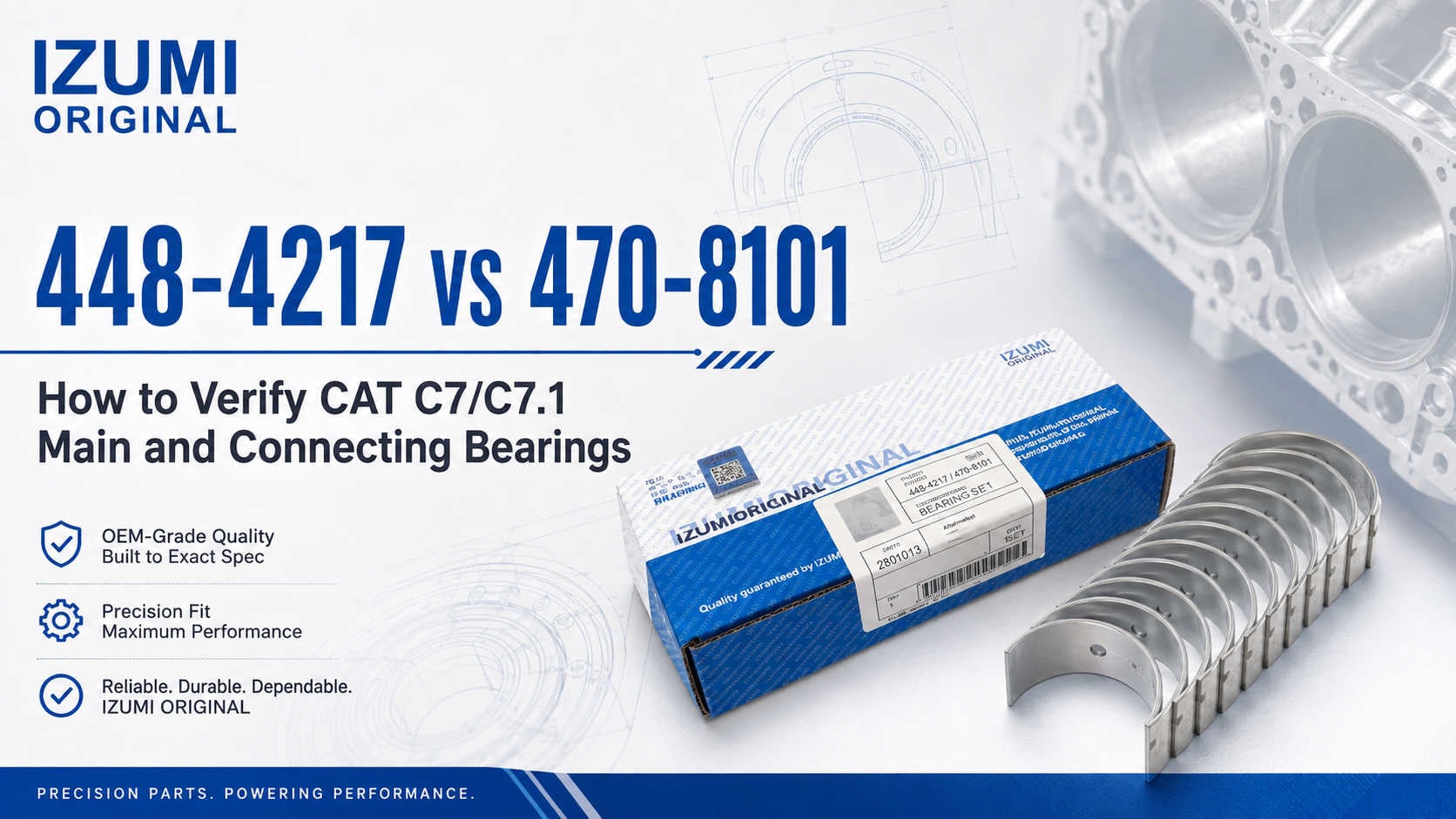
Caterpillar engine parts · buyer verification guide
448-4217 vs 470-8101: How to Verify CAT C7/C7.1 Main and Connecting Bearings
A search for a 448-4217 bearing often leads to the number 470-8101 on the same product page. That does not, by itself, prove that the two numbers describe the same part, the same bearing position, or a pair that fits every CAT C7 or C7.1 configuration. The safe buying decision starts with the engine identity and the current parts catalog, then moves to the old bearing markings and physical evidence.
Table of contents
Why 448-4217 and 470-8101 Appear Together
The current IZUMI ORIGINAL product listing places 4484217, 448-4217, and 470-8101 in one title and identifies the item category broadly as “Main Bearing Con Bearing.” That page is a useful commercial starting point, and buyers can review the C7.1 main and connecting bearing listing. However, the listing does not publish a position-by-position application table, dimensional drawing, engine serial range, or an explicit statement that the two numbers are interchangeable.
Numbers can appear together for several legitimate reasons: a listing may cover more than one bearing group, may combine a main-bearing reference with a connecting-rod-bearing reference, may show formatted and unformatted versions of the same number, or may serve several configurations that require separate catalog confirmation. The page title alone cannot tell the buyer which explanation applies.
This is why “versus” should mean compare and verify, not assume a substitution. A supplier should be able to map each quoted line to the buyer’s catalog evidence. If the quote simply repeats both numbers without identifying the required bearing location, quantity, size condition, and engine configuration, the order is not ready for approval.
Main Bearings and Connecting-Rod Bearings Do Different Jobs
Main bearings support the crankshaft in the cylinder block. Connecting-rod bearings operate at the crankpin journals between the connecting rods and crankshaft. Both are precision engine bearings, but they occupy different locations and are not selected by visual similarity. Their shell features, set composition, oil-hole or groove arrangement, and catalog position must match the intended location.
A complete engine family name is still not enough. Engines sold under related model labels may have changes by serial number, arrangement, production revision, or service history. An earlier crankshaft repair may also affect the bearing size now installed. Therefore, the old shell is evidence of the engine’s current condition, while the parts catalog is evidence of the intended configuration. Buyers need both.
Do not infer a repair size from color, box artwork, or a marketplace description. Do not assume that “STD” written in an old purchase record reflects the part currently inside the engine. If a journal was previously machined, the correct replacement decision depends on verified measurements and the applicable service information. The workshop performing the rebuild should make that determination.
A Seven-Step Bearing Verification Workflow
1. Record the engine identity exactly
Photograph the entire engine nameplate in focus. Transcribe the engine model, complete serial number, and arrangement or configuration number exactly as displayed. Include the machine model and machine serial number when available, but do not use the machine model as a substitute for engine data. Caterpillar’s official parts-diagram workflow asks users to add equipment and a serial number to obtain relevant diagrams, reinforcing why serial-specific lookup comes first.
2. Use the current catalog for that serial number
Open the current parts manual, Parts.Cat.Com, SIS access, or dealer-supported lookup for the identified asset. Navigate through the crankshaft, main-bearing, and connecting-rod groups rather than searching only by a remembered number. Save a screenshot or PDF excerpt that shows the group description, part number, quantity, notes, and any effectivity information. Caterpillar explains that parts manuals provide exploded views and serviced part numbers and that catalogs should be selected by serial-number prefix or serial number.
3. Separate each bearing position on the request
Write “main bearing set” and “connecting-rod bearing set” on separate RFQ lines. If 448-4217 and 470-8101 both appear in the catalog, copy the description beside each number rather than asking the supplier to guess the relationship. If only one appears, include the catalog evidence and ask whether the other number is a supersession, a different position, or simply another item covered by the web listing. Require documentary confirmation before accepting any claim.
4. Photograph every old-shell marking
Clean only enough to make markings readable without damaging evidence. Photograph the back of representative upper and lower shells, locating tangs, oil holes, grooves, packaging labels, and any size or manufacturer marks. Keep shells organized by cylinder or main position. A pile of mixed shells removes information that could help the workshop identify uneven wear or a prior nonuniform repair.
5. Let the rebuilder verify journal condition and size
The workshop should inspect the crankshaft and housing condition using the correct service procedure and calibrated equipment. Ask for the measured result and the specified acceptance basis, not an estimate from a phone photograph. This article intentionally provides no dimensions, oil-clearance limits, or torque figures because those values must come from service information for the exact configuration.
6. Compare the supplier’s quote line by line
The quote should identify the number supplied, bearing location, set contents, size designation, brand or manufacturer shown on the offer, and the evidence used for fitment. Ask for current photos of the offered label and shell markings when possible. A generic catalog image can help show product type, but it does not prove the exact item that will be shipped.
7. Resolve every mismatch before payment
Stop if the nameplate, catalog, old shell, or quotation points to different numbers. The resolution may require a corrected serial entry, a later catalog, a dealer clarification, or workshop measurement. Do not solve a contradiction by choosing the number with the lower price, the faster delivery claim, or the most similar photograph.
448-4217 vs 470-8101: Buyer Comparison Table
| Reference | What the live site establishes | What remains unconfirmed | Required buyer action |
|---|---|---|---|
| 448-4217 / 4484217 | Appears in a C7.1 product title covering main and connecting bearings. | Exact bearing position, set contents, size condition, effectivity, and relationship to 470-8101. | Match it to the serial-specific catalog line and old-shell evidence. |
| 470-8101 / 4708101 | Appears in the same product title and bearing category. | Whether it is a different position, a later reference, a supersession, or applicable to the buyer’s engine. | Request the catalog description and documentary cross-reference for the exact serial number. |
| CAT C7/C7.1 bearing | A useful engine-family search phrase. | It does not identify the individual engine configuration or current crankshaft condition. | Provide the full nameplate, serial, arrangement, catalog page, and measurements. |
What to Inspect Before Ordering
Bearing damage can be evidence of a wider problem. The rebuilder should not treat new shells as a complete repair if the crankshaft, housings, oil supply, contamination control, or assembly process remains questionable. Preserve the old parts and oil-filter evidence until the cause of failure has been considered.
Ask the workshop to document journal surface condition, housing condition, oil-passage cleanliness, locating features, and shell contact pattern. Also check whether the removed sets are uniform across all positions. These observations do not replace the specified inspection procedure, but they create a traceable record for the parts inquiry and rebuild decision.
For broader sourcing, buyers can review the site’s Caterpillar engine parts category and additional engine parts listings. Use those pages to locate candidate products, then return to serial-specific verification. A category page is not a fitment certificate.
RFQ Checklist for a 448-4217 Bearing Inquiry
- Engine model exactly as shown on the nameplate
- Complete engine serial number and arrangement/configuration number
- Machine model and serial number, if relevant
- Current catalog page or screenshot for the identified serial
- Separate request lines for main and connecting-rod bearings
- All old-shell numbers, letters, logos, and size markings
- Clear front, back, tang, groove, oil-hole, and packaging photos
- Workshop-confirmed journal and housing inspection results
- Requested set contents and quantity by bearing position
- Supplier confirmation of the exact offered number and size designation
- Written explanation for any proposed supersession or cross-reference
- Final catalog and service-information check before installation
Frequently Asked Questions
Are 448-4217 and 470-8101 interchangeable?
Do not assume so. The live product page places both references in one title, but it does not provide an interchangeability statement or position-by-position application table. Confirm each number in the current catalog for the exact engine serial number and arrangement.
Which number is the main bearing and which is the connecting-rod bearing?
The available site listing does not explicitly map the two numbers to those positions. Use the serial-specific parts diagram or manual and ask the supplier to quote the catalog description beside each number. Avoid assigning the positions from title order.
Can I order with only “CAT C7.1” and a photo?
That is not enough for a controlled purchase. Provide the complete engine serial number, arrangement or configuration, old bearing markings, catalog evidence, and workshop measurements. Related engine labels can cover configuration differences that are invisible in a general photo.
What if the old bearing number does not match the catalog?
Pause the order. Recheck the serial data, catalog revision, bearing position, and whether the crankshaft was repaired previously. Ask a qualified rebuilder and parts specialist to reconcile the evidence before selecting a replacement.
Should I reuse torque values from another C7 rebuild?
No. Use the current service manual for the exact engine configuration and procedure. This guide deliberately does not publish torque values or clearances because an unsupported value can create an unsafe or expensive assembly error.
Reference Sources
- Cat Parts Store: Parts Diagram Lookup by Serial Number
- Caterpillar: Know Your Machine Better With Manuals
- MAHLE Aftermarket: Bearings Catalog 2025
Editorial note: Product numbers in this guide are treated as buyer-supplied or listing-derived references. No claim of OEM identity, equivalence, supersession, serial-number effectivity, stock, price, certification, or warranty is made. Always verify against current documentation for the exact engine.